
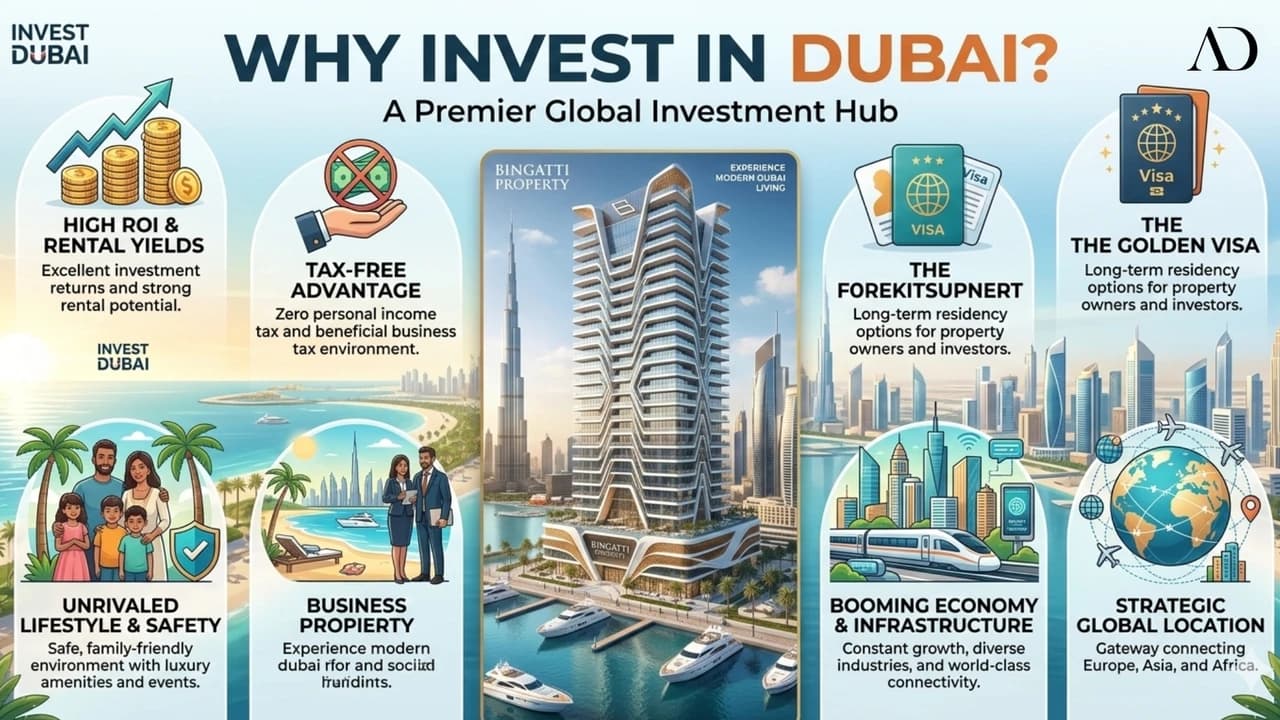
Dubai is one of the few global cities where property investors can combine a strong lifestyle market with clear ownership rules, residency pathways linked to real estate, and a cost structure that is often lighter than many Western markets (for example, no annual residential property tax is commonly noted, while buyers mainly plan for one-time transaction fees and ongoing service charges).
Reasons Dubai property investment attracts global buyers
Before you look at projects, it helps to understand why so many international buyers consider Dubai a “core market” for property ownership, not just a trend.
1) Ownership access for foreigners in designated areas
Dubai allows expats and foreign nationals to own property in designated freehold areas, which gives many international buyers comfort because ownership is registered and regulated through official systems. The key is buying in the correct zones and ensuring the transaction is registered properly.
What to do as a safe first step
Confirm the ownership type (freehold vs other structures)
Ensure the transaction is registered through the right channel and paperwork
Work only with brokers who give everything in writing (unit specs, fees, timelines)
2) Residency options linked to property ownership
For many buyers, Dubai’s residency pathways are part of the value. Dubai Land Department’s services outline:
A property investor residence permit pathway tied to a minimum property value of AED 750,000 (as stated on the DLD investor residence service page).
A “Golden Visa investor” pathway tied to property value of AED 2 million, with additional conditions (including mortgaged property conditions and documentation).
Why this matters in real life
Even if you’re not moving immediately, residency options can add flexibility for travel, long-term planning, and family arrangements.
3) A tax and fee structure many investors find attractive
Dubai is often described as having no annual residential property tax, while buyers should plan for transaction fees and ongoing service charges.
At purchase, one of the most commonly referenced costs is the Dubai Land Department (DLD) transfer fee of 4% (often paid by the buyer in practice unless agreed otherwise), plus other admin/trustee-related charges depending on transaction type.
Simple budgeting rule
Don’t calculate returns using only “rent minus mortgage.” Always include:
Service charges
Maintenance and vacancy buffer
Transaction costs (especially if you might resell in a few years)
4) A market that supports both lifestyle buyers and pure investors
Dubai is not only an “investor city.” It’s a lifestyle city too. That matters because lifestyle demand supports resale. In practice, Dubai has multiple buyer pools:
End-users who purchase for family living and quality of life
Corporate tenants and professionals who rent near business hubs
Second-home owners who spend part of the year in the UAE
This mixed demand can help certain communities stay liquid, especially those with strong connectivity, daily convenience, and good property management.
How to pick the right strategy
Different strategies win in different situations. Use this section to match your plan to the right property type.
Off-plan vs ready: which fits you better?
Many new buyers start with the wrong question (“Which project is best?”). Start with this: “Do I need the keys now?”
Off-plan (new launch / under construction)
Off-plan can suit buyers who:
Want staged payment plans
Prefer newer communities and fresh amenities
Can wait until handover and are comfortable tracking milestones
Important protection note: Dubai’s framework includes escrow and interim registration mechanisms for off-plan transactions; always ensure the project and disposal are handled through compliant processes and registered correctly.
Ready property (completed)
Ready properties can suit buyers who:
Want immediate move-in or immediate rental income
Prefer inspecting the exact unit, view, and building condition
Want clearer insight into service charges and building management quality
Rental income vs capital growth: what you should prioritize
Both are valid, but the selection criteria changes.
If you want rental income
Focus on “rentability” more than brand name:
Practical layouts (easy furnishing, usable storage)
Buildings with strong maintenance reputation
Access to daily essentials (supermarkets, gyms, transport routes)
Tenant-friendly features (parking, security, efficient lift flow)
If you want long-term growth
Focus on “future desirability”:
Master-planned communities with long-term lifestyle pull
Scarcity features (waterfront, landmark views, limited supply unit types)
Developer execution quality and handover reputation
Areas with a clear upgrade path over time (infrastructure, retail, community maturity)
The due diligence checklist that protects your money
Dubai is full of opportunity, but the strongest investors are the ones who buy with discipline.
Verify the full cost picture
A lot of mistakes happen because buyers focus on “starting price” and forget the rest. Make sure you ask for:
All purchase fees (DLD, trustee/admin where applicable)
Expected service charges (or comparable benchmarks)
Maintenance assumptions
Mortgage costs (if financing)
Vacancy buffer (even good units can sit empty sometimes)
The DLD transfer fee is commonly stated as 4% of the purchase price, and guides note it is often paid by the buyer unless otherwise agreed.
Confirm everything important in writing
Get written clarity on:
Net area (not only brochure size)
Balcony/terrace size
Parking allocation and storage (if any)
Finish inclusions (appliances, wardrobes, flooring, bathroom fittings)
Payment schedule milestones (for off-plan)
Handover/snags process expectations
Think like your future buyer
A strong purchase is easy to explain in one sentence:
“Bright layout, easy parking, great view, and the building is well managed.”
If you can’t explain the value simply, it’s usually a sign you’re buying hype, not fundamentals.
Common mistakes international investors make in Dubai
Avoid these and you’ll already be ahead of most first-time buyers.
Mistake 1: Buying a weak layout in a good area
Area helps, but layout sells. Units with awkward living spaces or poor privacy struggle in both rental and resale markets.
Mistake 2: Ignoring service charges
Many investors overestimate net yield because they forget service charges and maintenance. Always estimate conservatively.
Mistake 3: Overpaying because the marketing is strong
Dubai marketing is world-class. Your protection is comparison:
Compare 2–3 similar units
Compare building management quality
Compare service charges and amenities you’ll actually use
Mistake 4: Assuming residency is automatic
Residency pathways have criteria and documentation requirements. Use official sources for thresholds:
Investor residence route on DLD: AED 750,000 minimum property value (per the service description).
Golden Visa investor route on DLD: AED 2 million property value with conditions listed.
Why Autograph Realtors stands out
Autograph Realtors doesn’t operate like a “send 50 listings and push you to book” brokerage. We work shortlist-first and documentation-first. That means we help you choose based on what actually protects you: unit layout quality, privacy, light, building management, total cost clarity, and a realistic plan for rent or resale. If something is unclear, overpriced for its fundamentals, or doesn’t fit your timeline, we tell you early. It’s a calmer process, and it leads to better decisions.
A simple action plan you can follow this week
If you want to move from “research mode” to “decision mode,” do this:
Step 1: Decide your buying style
Ready home for certainty and immediate use
Off-plan for staged payments and newer communities
Step 2: Pick 2–3 target areas
Choose based on your lifestyle and tenant profile, not only on social media trends.
Step 3: Build a shortlist of 3 properties
One “safe” option (strong rentability, proven building)
One “upgrade” option (better view/feature, slightly higher cost)
One “growth” option (early community / future upside)
Step 4: Compare using one scorecard
Layout usability
Light and privacy
Building management feel
Total cost (including service charges)
Exit story (who buys this later?)
If you share your budget range, whether you want ready or off-plan, and your goal (live, rent, or growth), I’ll structure a tight shortlist strategy you can use to evaluate options without getting overwhelmed.