
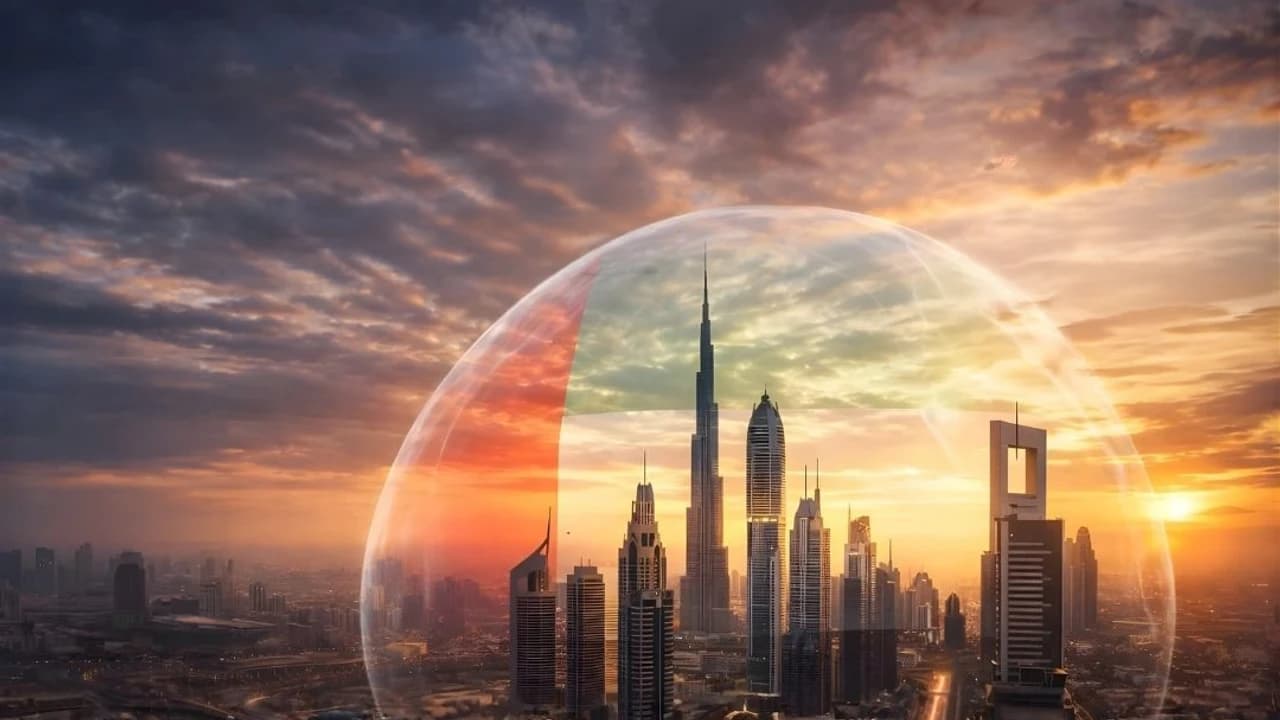
Dubai real estate has a consistent track record of not just surviving global economic turbulence but actually growing through it. When stock markets dip, currencies weaken, and investor confidence shakes across the world, Dubai's property market tends to attract more attention, more capital, and more buyers, not less. In 2025, the market recorded over 270,000 transactions worth AED 917 billion, a 20% rise year on year, making it the strongest performance in the sector's history. If you are thinking about whether to buy property in Dubai or wondering if this is the right time to sell property in Dubai, the answer is written clearly in the numbers and the fundamentals that drive this market every single year.
The Current State of Dubai Real Estate in 2026
Before understanding why Dubai real estate rises through global challenges, it helps to see where the market stands right now.
In the first quarter of 2026 alone, Dubai recorded nearly 48,000 property transactions worth AED 176.7 billion, with transaction values rising 23.4% year on year. Off-plan properties continued to lead the way, accounting for around 70% of total transaction activity. This is not a market slowing down. It is a market finding new levels of momentum every quarter.
Here is a snapshot of where things stand today:
Residential sales transactions in 2025 reached 202,349, a figure 464% higher than in 2021.
The total value of real estate transactions reached AED 539.9 billion in 2025, up 24.67% compared to 2024.
Average gross rental yields stood at approximately 7% for apartments and around 5% for villas and townhouses by the end of 2025.
86% of property purchases in Dubai during 2025 were made in cash, reflecting the strength and quality of buyers entering the market.
Dubai's population surpassed 4 million in 2025, with estimates suggesting an additional 175,000 to 225,000 residents could be added in 2026.
These are not vanity numbers. They reflect genuine demand from real people making real long-term commitments to this city.
Why Dubai Keeps Growing When the Rest of the World Wobbles
This is the question that every serious investor asks. The world has gone through inflation shocks, geopolitical tensions, interest rate changes, and trade disruptions. Yet Dubai's property market has responded to each of these episodes by recording higher transaction volumes and higher values. Here is why that keeps happening.
A Government That Plans Decades Ahead
Dubai's leadership operates on a long-term planning horizon that most cities simply do not match. The Dubai Real Estate Sector Strategy 2033 is already in motion, with a clear target of pushing transaction volumes up by 70% to reach AED 1 trillion. The Dubai 2040 Urban Master Plan has already mapped out how the city will accommodate a population of 5.8 million residents with new communities, green spaces, transit networks, and economic zones.
When investors see this level of institutional commitment, it removes a lot of the uncertainty that makes other markets feel risky. The city is not just reacting to growth. It is engineering it.
Zero Tax Remains a Powerful Magnet
One of the most straightforward reasons global investors choose to buy property in Dubai is the tax environment. There is no income tax, no capital gains tax, and no property tax. This is not a loophole or a temporary incentive. It is a structural feature of how the UAE economy is designed to attract global talent and capital.
Compare this to property markets in the UK, the United States, or Europe where capital gains taxes, stamp duties, and annual property taxes eat into returns significantly. A 7% rental yield in Dubai stays close to 7% in your pocket. The same yield elsewhere often looks much smaller after tax.
The Golden Visa Has Changed Who Buys Here
The UAE Golden Visa program has fundamentally shifted the buyer profile in Dubai's property market. Professionals, entrepreneurs, remote workers, and high-net-worth individuals who previously rented or remained in their home countries are now buying homes because the visa gives them long-term residency tied to property ownership.
This has created a new category of buyer: someone who does not just want a return on investment but also wants to live here, raise a family here, and build a life here. That type of demand is far more stable than speculative buying, and it is exactly the kind of foundation that keeps prices supported even when global sentiment softens.
Population Growth Creates Real, Consistent Housing Demand
Dubai added over 200,000 residents in 2025 alone. Using an average household size of approximately four people, this level of population growth implies demand for roughly 50,000 additional homes, even before accounting for replacement demand, upgrades, or second-home purchases.
This is not demand manufactured by marketing. It is demand created by people actually moving to the city. When that many new residents arrive every year, there is a very natural pressure on housing supply that keeps both rental rates and property values moving upward.
How Dubai Real Estate Has Responded to Past Global Crises
To understand why investors and homeowners feel confident today, it is worth looking at how the market has behaved during some of the most difficult moments in recent global history.
After the 2008 Financial Crisis
The 2008 global financial crisis hit property markets everywhere, and Dubai was not immune. But what followed was the beginning of one of the most remarkable regulatory transformations in real estate history. The government introduced the Real Estate Regulatory Agency, escrow account requirements for developers, and a series of protections for buyers. These reforms built the foundation of trust that now makes Dubai one of the most investor-friendly property markets in the world.
During the COVID-19 Pandemic
When COVID-19 shut down travel and created global economic uncertainty, most analysts expected Dubai's property market to suffer significantly. What happened was the opposite. Demand for villas and spacious homes surged as people re-evaluated how they wanted to live. Remote work made locations like Dubai more accessible to international buyers. The government moved quickly to support residents and businesses, and by 2021, the market was already in full recovery mode.
During the Current Period of Global Geopolitical Tension
The market continues to show clear resilience even against a backdrop of regional uncertainty, according to Firas Al Msaddi, CEO of fäm Properties. This resilience is not accidental. It comes from Dubai's position as a politically neutral business hub, a city that has built diplomatic and trade relationships across Asia, Europe, Africa, and the Americas simultaneously.
When investors feel uncertain about other markets, Dubai often becomes the destination they move capital toward, not away from.
What Makes People Buy Property in Dubai Right Now
Whether you are a first-time buyer or an experienced investor looking to expand your portfolio, the reasons people choose to buy property in Dubai right now are both practical and compelling.
Rental income from day one is a realistic outcome. Rental yields average 6 to 7% gross in Dubai, among the world's highest, making the city attractive for both end-users and investors. Compare that to London or New York where gross yields typically sit between 2% and 3%, and the advantage becomes obvious.
Off-plan payment plans have made entry more accessible. Developers across the city now offer flexible payment structures that allow buyers to spread their investment over three to five years, sometimes with no interest attached. This means you can secure a property at today's price while paying for it gradually as the project is completed.
The best areas to invest in Dubai balance lifestyle appeal with strong returns. Palm Jumeirah and Jumeirah Bay Island offer high-end villas with strong capital appreciation. Dubai Hills Estate attracts families with consistent off-plan launches. Jumeirah Village Circle provides affordable apartments with rising rental yields. Dubai South and Expo City offer infrastructure-driven growth with strong long-term potential.
Why This Is Also a Smart Time to Sell Property in Dubai
If you already own property in Dubai, the current market conditions are giving sellers a significant advantage. Values have risen consistently and in some segments dramatically over the past three to four years.
Villa prices have led the market, with average freehold villa values rising by 206% since the pandemic. For owners who purchased in 2020 or 2021, this represents an extraordinary opportunity to realise capital gains that would be impossible to achieve in most other global cities.
The secondary market is equally active. The secondary market performed strongly in 2025, with 66,400 resales worth a total of AED 238.8 billion, up 26.2%. Buyers are actively looking for ready properties because supply of desirable completed units in prime areas remains limited relative to demand.
If you are considering whether to sell property in Dubai, the combination of high buyer appetite, strong pricing, and limited inventory in established communities creates a seller's market in many of the most sought-after locations.
The Trends Shaping Dubai Property in 2026 and Beyond
Understanding where the market is headed helps both buyers and sellers make better decisions. Here are the key trends defining Dubai real estate right now.
Smart and Sustainable Developments
New residential projects increasingly feature smart home technology, energy-efficient systems, EV charging infrastructure, and green building certifications. Buyers are not just looking for location and price. They want developments that reflect how people want to live in 2026 and beyond. Developers who are delivering this are seeing faster sales and stronger pricing.
Luxury Demand Remains Resilient
Luxury property investments reached AED 3.98 billion in 2025, an increase of 5%, while the super-prime market continues to attract global ultra-high-net-worth buyers. Areas like Palm Jumeirah, Emirates Hills, and Jumeirah Bay Island are commanding prices that place them among the most competitive luxury markets globally.
Women Are Investing in Dubai Property at Record Levels
Investment by women in Dubai real estate grew significantly in 2025, reaching AED 154 billion through 76,700 deals, representing a 31% increase in value and a 24% increase in the number of transactions. This reflects how inclusive and accessible Dubai's property market has become for a global investor base that continues to diversify.
The Off-Plan Market Is Maturing
Off-plan was once associated with high risk and developer uncertainty. Today, strict escrow regulations, clear handover timelines, and a transparent regulatory environment have made off-plan purchases one of the most popular routes into Dubai real estate for international buyers looking to maximise returns on a longer time horizon.
Why Autograph Realtors Stands Out in Dubai's Property Market
At Autograph Realtors, we bring something that numbers alone cannot offer: a team that genuinely understands this market at a human level. We work with buyers, sellers, and investors across every segment of Dubai's property landscape, from first-time buyers stepping into the market for the first time to seasoned investors managing multi-property portfolios. Our approach is simple. We listen to what you need, match that honestly to what the market offers, and guide you through the process with full transparency at every step. We are not here to push transactions. We are here to build relationships that create long-term value for every client who trusts us with their property journey in one of the world's most exciting real estate markets.
Final Thoughts
Dubai real estate is not resilient by luck. It is resilient by design. The regulatory infrastructure, the tax environment, the government's long-term planning approach, and the city's genuine appeal to global residents and investors create a set of conditions that are genuinely rare anywhere in the world.
As Knight Frank noted, the sustained momentum in market activity reflects the city's evolution from a speculative real estate market to one characterized by genuine end-user demand, structural depth, and long-term investor confidence.
Whether you want to buy property in Dubai for personal use, rental income, or long-term capital growth, or you are ready to sell property in Dubai and realise the gains that have built up over the past few years, the market today offers clear and compelling reasons to act. The fundamentals that have driven Dubai's property market through every global crisis remain not just intact but stronger than ever heading into 2026 and beyond.