
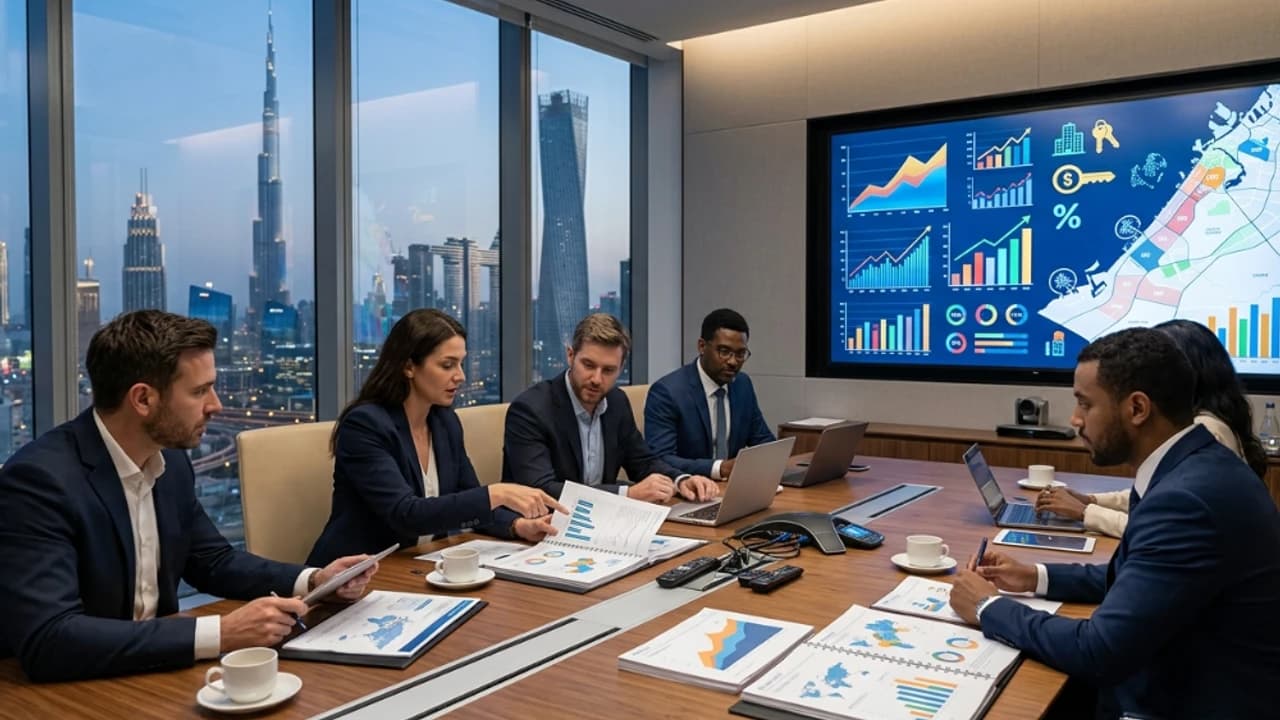
Dubai's property market recorded AED 28.51 billion in total transactions during May 2026, covering 10,218 deals across residential and commercial segments. That figure alone tells you the market is still very much alive and moving. While volume has come off the pace set in early 2026, the numbers from May paint a picture of a city where property continues to attract serious money from buyers across the globe. If you are watching this market closely, whether you want to buy your first home, grow a portfolio, or simply understand where prices are heading, this report breaks it all down in plain language.
The Big Picture: Where Dubai Real Estate Stands in May 2026
The first five months of 2026 saw a total of 66,900 residential sales transactions completed in Dubai, according to research from Cavendish Maxwell. The combined value of those deals reached AED 196.2 billion, which is roughly $53.4 billion. These are not small numbers. They confirm that Dubai remains one of the most active property markets anywhere in the world.
May itself was a quieter month compared to earlier in the year. Around 9,500 residential transactions were recorded during May, down from 17,600 in the same month in 2025. Part of that decline was driven by the Eid Al Adha holiday break, which reduced activity by an estimated 3,000 transactions on its own. The overall moderation in pace is not a cause for alarm. It reflects buyers becoming more selective, not buyers stepping away.
The key takeaway from the headline numbers is this: transaction growth is moderating, but Dubai's residential market still operates at a healthy level by any historical measure.
Understanding What "Moderation" Actually Means
Some people hear "slowdown" and immediately think the market is falling. That would be the wrong conclusion here. What is happening is a shift from a market that was running at exceptional speed to one that is now running at a more measured, sustainable pace. Buyers are doing more research. They are comparing communities. They are weighing payment plans. That is actually a healthy sign of market maturity.
Ronan Arthur, Director and Head of Residential Valuation at Cavendish Maxwell, described it this way: while off-plan sales remained relatively resilient during the first four months of 2026, May recorded a notable decline in both transaction volumes and values. The ready market has seen an even more pronounced slowdown, with year-on-year declines since March. This is a more selective market environment, with buyers taking a measured approach amid regional and global uncertainty.
Off-Plan Properties Dominate: 74 Percent of All Deals
One of the most defining features of Dubai's 2026 property market is the extraordinary dominance of off-plan transactions. Between January and May 2026, off-plan purchases accounted for approximately 74 percent of all residential deals. That is a striking figure.
In May alone, off-plan homes produced 7,079 sales worth AED 14.18 billion. That represents roughly 64 percent of total residential value and almost three quarters of residential deal volume in the month.
Why Are So Many Buyers Choosing Off-Plan?
There are several clear reasons behind this trend.
Off-plan properties come with staged payment plans that reduce the immediate financial pressure on buyers
Newer projects offer access to the latest designs, smart home features, and premium amenities
Entry prices are often lower than ready properties in the same communities
Developers are launching in master-planned districts with strong long-term appeal
Investors see capital appreciation potential between purchase and handover
The off-plan market is not just popular with investors. End-users are also choosing off-plan because they can secure their preferred unit in the community they want, often before completion drives up prices.
Ready Properties: Secondary Market Stays Relevant
While off-plan grabs the headlines, the secondary or ready property market continues to hold its own. In May 2026, buyers completed 2,422 resale transactions worth AED 7.74 billion. The average transaction value in the secondary market was approximately AED 3.2 million, noticeably above the off-plan average near AED 2 million.
This price gap matters. Ready homes in established communities carry premium values because they offer:
Immediate occupancy with no waiting period
Existing rental income from day one
Neighbourhood services, schools, and retail already operational
Less delivery risk compared to off-plan projects
For buyers who do not want to wait two or three years for handover, the secondary market remains a solid option, especially in communities where supply is relatively tight.
Dubai Property Prices by Community: What the Numbers Show for Q3 and Q4 2026
Property Finder's community-level price forecast data reveals something important: Dubai no longer moves as a single market. Different areas are following completely different trajectories based on local supply, demand, and the volume of upcoming handovers.
Here is where prices stand and where they are heading:
Dubai Hills Estate sits at around AED 2.47 million average in Q2 2026, expected to dip slightly in Q3 before recovering to approximately AED 2.55 million in Q4
Palm Jumeirah is at roughly AED 7.52 million in Q2, nearly flat in Q3, then rising to around AED 7.77 million in Q4
Jumeirah Village Circle averages about AED 1.15 million in Q2, with only modest movement expected through the rest of the year due to heavy supply
Business Bay sits near AED 1.90 million in Q2 with modest Q4 stabilisation expected
Al Jaddaf is one of the standout performers, expected to rise from AED 1.68 million in Q2 to above AED 2.17 million by Q4, driven by infrastructure development and waterfront positioning
Scarcity vs Supply: The Factor That Determines Everything
The single biggest driver of price direction in Dubai right now is supply. Communities where new land or replacement stock is genuinely limited, such as Palm Jumeirah and Dubai Hills Estate, are holding firm or strengthening. Communities where developers are launching new projects at pace, such as Jumeirah Village Circle, Business Bay, and Dubai South, are experiencing softer demand as buyers have more choice and less urgency.
This is not a crisis for the high-supply communities. It is an opportunity for buyers who want negotiating power. In areas like JVC, patient buyers can compare multiple options, negotiate on price, and secure better payment terms. In scarcity markets, waiting can actually reduce your options rather than improve your position.
Commercial Real Estate: The Office Market Hits a 15-Year High
One of the most remarkable stories in Dubai's May 2026 data is the commercial property performance. Office transactions generated AED 2.52 billion during the month, leading all commercial asset classes. Whole building deals added AED 1.77 billion, and land transactions contributed AED 1.18 billion.
Together, offices, whole buildings, and land produced more than AED 5.4 billion in commercial turnover during May alone. The Dubai office sales market has surged 203 percent to $2.2 billion, reaching a 15-year high. This reflects growing demand from businesses expanding into Dubai as the city's role as a regional headquarters location continues to strengthen.
The average commercial transaction in May was approximately AED 9.1 million, compared to AED 2.3 million for residential deals. That gap highlights where institutional and corporate capital is flowing in this market.
Global Investor Confidence in Dubai Remains Remarkably High
One of the most telling signals about Dubai's property market in 2026 comes not from local data but from global investor surveys. More than 56 percent of global investors now say they want exposure to UAE property. Separate research confirms that the UAE beats both the US and UK as the world's top property investment destination among global capital allocators.
That confidence is not accidental. It is built on several structural factors:
Dubai's infrastructure pipeline continues to deliver world-class connectivity and livability
The residency and ownership policies being updated in 2026 are making the market more accessible to international buyers
The city's business environment keeps attracting new companies, creating fresh housing demand
A stable regulatory framework gives investors confidence that the rules will not change overnight
The UAE real estate sector as a whole is projected to reach $811 billion by 2031, according to Statista Market Insights
Farooq Syed, CEO of Springfield Properties, captured this well: "Dubai's real estate market is increasingly reflecting the city's broader economic story." Infrastructure, connectivity, and quality of life are not marketing slogans here. They are measurable reasons why demand stays consistent even when global markets face uncertainty.
First-Time Buyers Getting More Support in 2026
An important development in May 2026 is the growth of Dubai's first-home buyer programme. The scheme helped 3,200 residents purchase their first property in 2026, with 22 developers now participating. The programme offers discounts, priority access to select projects, and better financing structures for eligible buyers.
The programme also includes expanded VAT relief provisions. New rules are widening relief on home construction, including elements such as pools and smart home systems, with potential savings reaching up to AED 25,000 for eligible homeowners.
At Autograph Realtors, we see growing interest from first-time buyers who are using these new support structures to get into the market earlier than they expected. The combination of flexible payment plans from developers and government-backed first-home incentives is creating a genuine entry point that did not exist in the same form just a few years ago.
Construction Costs Are Reshaping How Developers Price Projects
One factor that does not always get enough attention in market reports is the impact of rising construction costs on off-plan pricing. In 2026, this is a real issue that buyers need to understand.
Building material costs have increased significantly compared to pre-pandemic levels, with some specialist materials and imported finishes rising by more than 50 percent in certain categories. Labour costs have also climbed as demand for skilled workers intensifies across Dubai's record project pipeline.
The result is that off-plan launch prices are increasingly reflecting actual build economics rather than aggressive discounting strategies. The traditional assumption that off-plan always meant a significant price discount below ready property values is less reliable in 2026.
Key cost pressures pushing launch prices higher include:
Steel and cement price fluctuations
Rising labour and logistics expenses
Higher financing and escrow compliance requirements
Faster delivery expectations from developers
Premium amenity and design standards in new launches
Not every developer is responding the same way. Large, financially strong master developers often have more flexibility to absorb some cost pressure through bulk contractor agreements and economies of scale. Smaller boutique developers may pass more of the cost inflation directly to buyers through higher launch prices.
For buyers, this means due diligence on developer track record, delivery history, and specification standards matters more than it did even two years ago.
Areas to Watch: The Communities with the Most Momentum
Based on the demand index and price forecast data for Q3 and Q4 2026, the communities showing the strongest signals worth watching include:
Damac Lagoons, which recorded a 69.8 percent year-on-year demand increase heading into Q3 2026
The Valley, with a 58.6 percent demand increase, driven by family-focused villa living
Mudon, up 34.1 percent year-on-year in demand as buyers seek master-planned suburban lifestyle
Dubai Hills Estate, with 28.9 percent demand growth supported by limited land availability
Al Jaddaf, where rising price expectations driven by waterfront adjacency and infrastructure investment are creating an interesting window before appreciation matures
Villa-led, master-planned communities are clearly leading the demand story in mid-2026. The market is rewarding areas that offer space, quality infrastructure, and long-term livability, not just convenient investor price points.
Rental Market: Signs of Stabilisation After Years of Growth
Dubai's rental market is entering a normalisation phase as 2026 progresses. After several years of sharp rental increases that tested affordability for many residents, the pace of rental growth is slowing in a growing number of communities.
The areas where rental prices are beginning to stabilise include many of the same apartment-heavy communities seeing softer sales demand, such as JVC, Dubai Sports City, and parts of Business Bay. In these areas, increasing residential supply is giving tenants more options and reducing landlords' ability to push rents sharply higher at renewal time.
In villa communities and prime locations, rental demand remains firm. Families looking for long-term Dubai residence continue to compete for quality stock in communities like Dubai Hills Estate, Arabian Ranches, and Jumeirah Golf Estates, keeping rental yields relatively strong in these segments.
What This All Means If You Are Buying, Selling or Investing Right Now
The May 2026 data confirms a few practical conclusions that should shape decisions in this market.
If you are buying for long-term residence or family living, communities with genuine scarcity and strong lifestyle infrastructure are the most resilient places to commit. The price floor in these areas is structurally supported. Waiting for a big discount is unlikely to be rewarded.
If you are investing for rental yield or capital appreciation, the analysis now requires community-level thinking rather than city-wide assumptions. The spread between strong communities and supply-heavy ones is widening. Getting this right matters more than it did three years ago.
If you are selling, the secondary market in high-supply areas is competitive. Pricing your property accurately and presenting it well is essential. Overpricing relative to comparable listings is a fast way to sit unsold while the market moves.
If you are on the sidelines waiting for a crash, the data does not support that strategy. Transaction volumes are moderating, not collapsing. Global investor demand for UAE property is near a multi-year high. The UAE sector is projected to reach $811 billion by 2031. The fundamentals of demand, infrastructure investment, business growth, and population expansion are all pointing in the same direction.
Final Thought: Dubai's Property Market is Maturing, Not Weakening
The story of Dubai's real estate market in May 2026 is a story of a market that is growing up. The days of every area rising at the same pace and every buyer rushing in without research are being replaced by something more sophisticated. Buyers are comparing communities, scrutinising developers, and thinking about long-term livability alongside short-term returns. That is a good thing.
For anyone serious about understanding where to act in this market, community-level data, construction economics, developer credibility, and supply pipeline timing are now the tools that separate good decisions from expensive ones.