
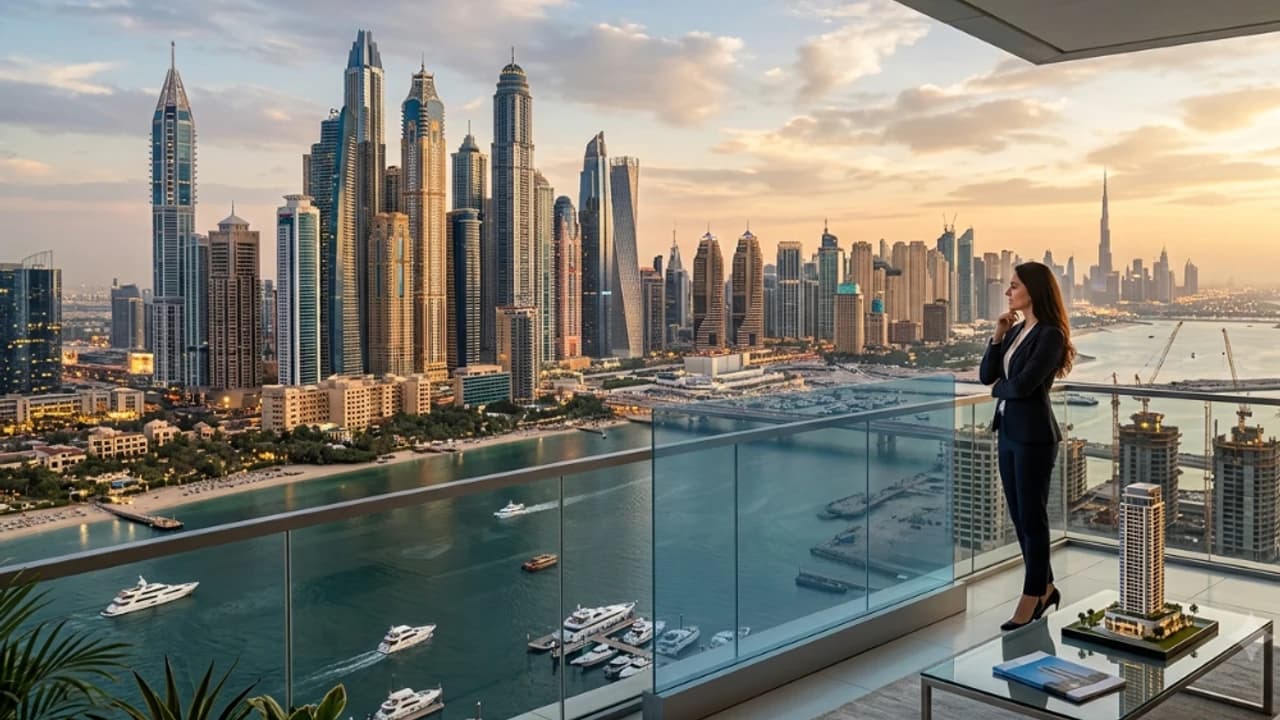
Dubai's residential property market registered about AED 182.9 billion in sales across 49,401 transactions in H1 2026, while total real estate activity across all asset types reached roughly AED 286 billion, one of the strongest half-years on record. The average price per square foot climbed 6.7% year-on-year to around AED 1,770, off-plan homes drove most of the volume, cash buyers funded about two-thirds of deals, and the luxury segment set new records. In short: prices kept rising at a healthy, sustainable pace, and 2026 favours buyers and investors who choose the right area and product rather than rushing in.
The full breakdown below covers pricing, transaction segments, mortgages, off-plan versus resale, top communities, developer activity, handovers, and the rental market, so you can see exactly where the numbers point.
The Market at a Glance
Dubai entered the second half of 2026 with a market that is large, liquid and noticeably more balanced than the frenzy of 2024 and 2025. The core signal is simple: activity stayed high, and values pushed even higher.
Headline residential figures for H1 2026:
Total residential transactions: 49,401
Total residential sales value: around AED 182.9 billion
Average price per transaction: about AED 3.7 million
Average price per square foot: roughly AED 1,770
Year-on-year price growth: 6.7%
For context, full-year 2025 saw about 213,700 residential transactions worth roughly AED 681 billion at an average of AED 3.2 million per sale and AED 1,600 per square foot. So even at the halfway mark, 2026's average sale price and price per square foot already sit above the entire previous year's averages. That is the clearest proof that pricing power remains firmly intact.
Prices and Value Trends
Steady Growth, Not a Spike
The market has shifted from explosive gains to consistent, single-digit appreciation. A 6.7% annual rise in price per square foot is the kind of growth that builds long-term wealth without inflating a bubble. For end users worried about overpaying, this slower climb is genuinely reassuring, because rents, salaries and mortgage capacity get time to catch up with property values.
Where the Money Is Going by Price Band
One of the most useful insights from H1 2026 is how evenly demand spread across price segments. This is not a market propped up by one buyer type.
Share of transactions by price segment:
Below AED 1 million: about 28.7%
AED 1 million to 2 million: about 32%
AED 2 million to 3 million: about 16.6%
AED 3 million to 5 million: about 11.5%
Above AED 5 million: about 11.2%
The takeaway: the AED 1–2 million band is the busiest sweet spot, showing strong end-user and investor appetite for well-priced apartments and starter homes. At the same time, the 11.2% share above AED 5 million confirms that premium and ultra-luxury demand is deep and durable, not a niche footnote.
Mortgage Market and Buyer Profile
The financing picture tells an interesting story that looks surprising at first glance.
Mortgage snapshot for H1 2026:
Mortgage transactions: 12,118
Total mortgage value: around AED 61.6 billion
Average loan-to-value: about 76.14%, up from the prior year
Cash-funded share: roughly 67% of all purchases
Mortgage transaction counts and total loan value fell sharply year-on-year, yet this is not a sign of weakness. It reflects two things happening together: cash buyers dominated the market, funding about two out of every three deals, while those who did borrow took on higher loan-to-value ratios. A rising LTV signals confidence that prices will keep appreciating, since buyers are comfortable financing a larger slice of each purchase. In plain terms, Dubai is drawing well-capitalised, committed buyers rather than speculators stretching their budgets.
Off-Plan vs Secondary – A Two-Speed Market
Off-plan and ready homes behaved almost like two separate markets in H1 2026, each attracting a different kind of buyer with different goals.
Off-Plan Market
Off-plan continued to carry most of the transaction volume, powered by flexible developer payment plans, lower entry points and brand-new master communities.
Off-plan apartments in H1 2026:
Units sold: 26,948
Sales value: around AED 56.8 billion
Average price: about AED 1.3 million
Average price per square foot: roughly AED 1,760
Leading areas: Dubai South (9.2%), Wadi Al Safa 5 (8%), Al Barsha South Fourth (7.2%), Wadi Al Safa 3 (6.6%), Dubai Islands (6.3%)
Off-plan villas in H1 2026:
Units sold: 6,015
Sales value: around AED 43 billion
Average price: about AED 4.1 million
Average price per square foot: roughly AED 1,790
Leading areas: Al Yelayiss 1 (47%), Al Yelayiss 5 (12.4%), Me'Aisem Second (8.2%), Dubai Investment Park Second (5.6%), Madinat Hind 4 (3.3%)
The standout here is Al Yelayiss 1, which alone accounted for 47% of off-plan villa transactions, showing how a single large master-planned launch corridor can dominate demand. Dubai South and Dubai Islands are also worth watching as newer growth engines pulling in serious buyer interest.
Secondary Market (Resale)
The resale market is smaller by value but arguably friendlier for negotiators right now, because you buy a physical, income-ready asset and can inspect the exact unit, view and building before committing.
Secondary apartments in H1 2026:
Units sold: 10,672
Sales value: around AED 21.1 billion
Average price: about AED 1.3 million
Average price per square foot: roughly AED 1,570
Leading areas: Al Barsha South Fourth (10.6%), Business Bay (8.5%), Marsa Dubai / Dubai Marina (7.9%), Al Merkadh (5.7%), Downtown Dubai (5.5%)
Secondary villas in H1 2026:
Units sold: 2,604
Sales value: around AED 18.5 billion
Average price: about AED 4.1 million
Average price per square foot: roughly AED 1,550
Leading areas: Wadi Al Safa 5 (10.3%), Al Hebiah Fifth (9.2%), Dubai South (6.7%), Al Yufrah 1 (6.6%), Wadi Al Safa 7 (5.6%)
Notice that resale price per square foot (around AED 1,550–1,570) sits below off-plan (around AED 1,760–1,790). That gap is the real cost of buying brand new, and it is exactly where a sharp negotiator can find value in ready stock.
Top Developers and Delivery
Who Led Construction
Developer activity concentrated among a handful of major names in H1 2026. DAMAC and Emaar each accounted for about 13% of total units delivered, and together the top five developers were responsible for roughly 45% of all residential handovers, with Select Group, Deyaar and Sobha rounding out the leaders. These developers operate across multiple communities and price points at once, which spreads supply and keeps confidence high.
The Handover Reality
Of all residential units scheduled for handover in 2026, only about 21% had actually been delivered by the end of H1, with the bulk expected in the second half. Construction delays are a normal, structural feature of Dubai's pipeline given the sheer scale of projects underway. For off-plan buyers, the practical lesson is to plan around realistic completion timelines rather than optimistic launch-day promises, and to prioritise developers with strong delivery track records.
The Luxury and Super-Prime Story
While the mainstream market moved at a measured pace, the top end sprinted. Dubai recorded around 296 home sales above the ten-million-dollar mark in H1 2026, worth roughly USD 5.1 billion, up about 14% year-on-year, according to Knight Frank. That keeps the city among the world's busiest ultra-prime property hubs.
What defines the luxury tier in 2026:
Ultra-wealthy buyers keep relocating for tax efficiency, safety, connectivity and lifestyle.
Prime residential prices, after surging roughly 25% in 2025, are forecast to grow far more modestly in 2026 as the segment stabilises.
Waterfront and branded residences on Palm Jumeirah, in the Marina district and across emerging island communities remain the most coveted trophy assets.
The slowdown in luxury price growth is a healthy plateau after an extraordinary run, not a downturn.
Dubai Rental Market
The rental side stayed remarkably stable, which matters enormously for investors chasing yield. Dubai registered about 169,439 rental contracts in H1 2026, only a marginal 1% dip year-on-year, signalling a mature, well-occupied rental pool rather than a cooling one. In some central districts, such as Business Bay, median rents actually eased, improving affordability for tenants and supporting faster occupancy, which is good news for landlords who value low void periods.
Communities widely tracked for strong rental yields in 2026:
Jumeirah Village Circle, a consistent mid-market favourite for balanced price and yield
Dubai Investments Park and International City, known for high gross yields on affordable stock
Business Bay and Dubai Marina, popular for central, tenant-ready apartments
Dubai Silicon Oasis and Arjan, offering steady returns in the mid-to-high single digits
The recurring lesson for a first-time investor is that the flashiest postcode rarely delivers the best cash flow. Reliable rental income tends to live in well-connected, affordable and mid-tier suburbs. Partnering with an experienced local brokerage such as Autograph Realtors can help translate these market-wide trends into a specific, community-level decision that fits your budget and goals.
What This Means for You
If You Are Buying to Live
Take your time. With cash buyers setting the pace and sellers more flexible on ready homes, you have room to negotiate and to choose based on location, commute and community quality rather than fear of missing out.
If You Are Investing
Follow yield and occupancy, not headlines. Mid-market communities are quietly outperforming glamour districts on cash flow, and stable rental demand protects your income. Pair an income-ready resale unit with a well-chosen off-plan launch from a proven developer for future upside.
If You Are Selling
Price to today's market, not the 2025 peak. Well-presented, fairly priced homes are still selling, while overpriced listings simply sit. Realistic pricing plus strong marketing is what closes deals in a calmer, more selective climate.
The Bottom Line
Dubai's real estate market in H1 2026 is best described as strong but sensible. Prices are still rising, cash buyers signal deep confidence, luxury keeps breaking records, and rental demand remains steady, yet the market has matured into a more balanced, selective phase. For buyers and investors, that shift is genuinely welcome: more negotiating power, less risk of overpaying, and more time to make an informed choice. The winners this year will not be the fastest movers. They will be the best informed.